
Table of Contents
- Why Dry Climates Demand Different Moisturizers
- Natural Ingredients for Dry Skin That Actually Work
- Oil or Cream for Dry Skin: Which Works Better
- Top Natural Moisturizers for Desert Climates
- How to Moisturize Skin in Dry Weather: Layering Routine
- Building a Skincare Routine for Dry Climates
- When Moisturizer Alone Isn't Enough
- Frequently Asked Questions
Last Updated: October 16, 2026
Why Dry Climates Demand Different Moisturizers
Dry climates challenge skin: low humidity pulls moisture out faster than temperate environments, and intense sun accelerates water loss. The best natural moisturizer for dry climate conditions must address this dehydration while protecting against dust, wind, and UV radiation.
Standard moisturizers designed for moderate climates often underperform in arid regions. The problem isn't applying more product, it's choosing formulations that work with your skin's biology.
Dry climates require moisturizers that combine three functions: drawing moisture in (humectants), sealing it in place (emollients and occlusive lipids), and protecting against environmental damage (antioxidants and adaptive botanicals). Without all three, skin stays compromised.
Natural Ingredients for Dry Skin That Actually Work
The most effective natural moisturizers for dry climates rely on specific botanical and biochemical ingredients. Understanding ingredient categories helps you evaluate products and build routines.
Humectants: Drawing Moisture Into Skin
Humectants are hygroscopic molecules that pull water from the air and deeper skin layers into the outer epidermis.
Sodium hyaluronate (the salt form of hyaluronic acid) is the most effective natural humectant for dry skin, holding up to 1,000 times its weight in water. The Organic Desert Nectar Serum from Mojave Desert Skin Shield uses it as a core ingredient to restore moisture to dehydrated complexions and create a hydrated, healthy glow.

Glycerin and urea function similarly at different molecular weights: glycerin works closer to the surface, urea penetrates deeper into the stratum corneum.
The critical limitation: humectants must always be sealed with occlusive ingredients in low-humidity environments. Applying a humectant serum alone in the desert is like filling a cup with a hole in the bottom.
Emollients and Occlusive Lipids: Sealing Hydration
Emollients are fats and oils that smooth the skin surface and fill gaps between skin cells. Occlusive lipids go further, creating a physical barrier that prevents transepidermal water loss (TEWL), the primary mechanism of moisture depletion in dry climates.
Rosemary leaf oil contains carnosic acid, a potent antioxidant that neutralizes free radical damage while providing occlusive protection. Parsley extract delivers apigenin, a flavonoid that calms inflammatory signaling and supports resilience against environmental stress.
Shea butter and plant-derived ceramides act as structural lipids, mimicking a healthy skin barrier. In dry climates they're necessities for preventing chronic dehydration and barrier dysfunction.
Oil or Cream for Dry Skin: Which Works Better
The choice isn't either/or, it's both/and. Oils and creams serve different functions in dry-climate skincare, and the most effective routines use them together in sequence.
Oils penetrate deeper and provide occlusive protection through their lipid structure, making them ideal as the final step to seal in previous layers. The Organic Nourishing Oil absorbs efficiently while maintaining its protective barrier, unlike mineral oil, which sits on the surface and feels greasy.

Creams are water-in-oil emulsions combining hydrating ingredients with occlusive lipids. They feel lighter than pure oils and work well as a middle layer. The Organic Replenishing Cream replenishes moisture while sealing hydration, for day and night use in desert conditions.
For truly dry skin in arid climates, layer both: serum → cream → oil. This ensures maximum hydration, barrier support, and occlusive protection; skipping any layer reduces efficacy.
| Product Type | Best For | Application Timing | Barrier Function |
|---|---|---|---|
| Serum (humectant-based) | Drawing moisture inward | First, on clean skin | Hydration foundation |
| Cream (emollient blend) | Sealing hydration mid-layer | After serum, before oil | Barrier support + comfort |
| Oil (occlusive lipids) | Final moisture lock | Last, over cream or serum | Maximum transepidermal water loss prevention |
Top Natural Moisturizers for Desert Climates
Mojave Desert Skin Shield's product line was developed specifically for arid, sun-exposed environments. Each formula addresses a critical function, and the most effective routines combine them strategically.
Organic Desert Nectar Serum: Hydration Foundation
Olive leaf juice has been used in traditional desert medicine for centuries. Modern formulation concentrates its protective compounds.
Its sodium hyaluronate draws moisture into the skin and plumps the complexion for a hydrated, healthy glow. Applied to clean, damp skin, it absorbs quickly without residue. Dermatologist-tested, vegan, and cruelty-free.
Best for: Anyone living in dry climates seeking a foundational hydrating serum that addresses both moisture loss and environmental damage.
Organic Nourishing Oil: Antioxidant Protection
Parsley extract delivers apigenin, a flavonoid that calms inflammatory signaling at the cellular level, meaningful protection where environmental stress triggers chronic inflammation.
The oil is recommended as Step 3 of The Gentle Desert Protocol, and also as the all-in-one 10-day skin detox protocol. It's deeply moisturizing, soothing, and strengthening. Dermatologist-tested, vegan, and cruelty-free.
Best for: Mature skin in need of intensive antioxidant protection and those seeking an all-in-one oil that addresses multiple desert-climate stressors.
Organic Replenishing Cream: Moisture Lock
The Organic Replenishing Cream ($130.00 for 3.4 oz) is the cream-form version of the Nourishing Oil, for those who prefer a lighter texture or need a mid-layer product. This lightweight, soothing formula replenishes and deeply seals moisture into the skin.
Excellent for mature skin needing extra hydration and protection, it works day and night. Apply it over the serum or oil to lock in moisture, aiding in the repair process.
Best for: Those seeking a cream-based occlusive that feels lighter than pure oil but provides serious moisture-sealing power for desert conditions.
Organic Chaparral Protective Mist: Environmental Barrier
The Organic Chaparral Protective Mist ($55.00 for 2 fl oz) serves a distinct function: environmental buffering. Native to Southwest deserts, chaparral (creosote) survives extreme temperature swings and harsh terrain.
This mist doesn’t leave residue and pairs well with cream, oil or foundation alike.
This blend of hydrosols and nourishing oils is excellent for quenching even the driest, most parched skin.
Best for: Frequent travelers, outdoor enthusiasts, and anyone needing portable environmental protection throughout the day.
Organic Replenishing Cream 3.4 oz →
How to Moisturize Skin in Dry Weather: Layering Routine
Sequence and timing matter more in dry climates than anywhere else. Proper layering ensures each ingredient works synergistically rather than competing for absorption.
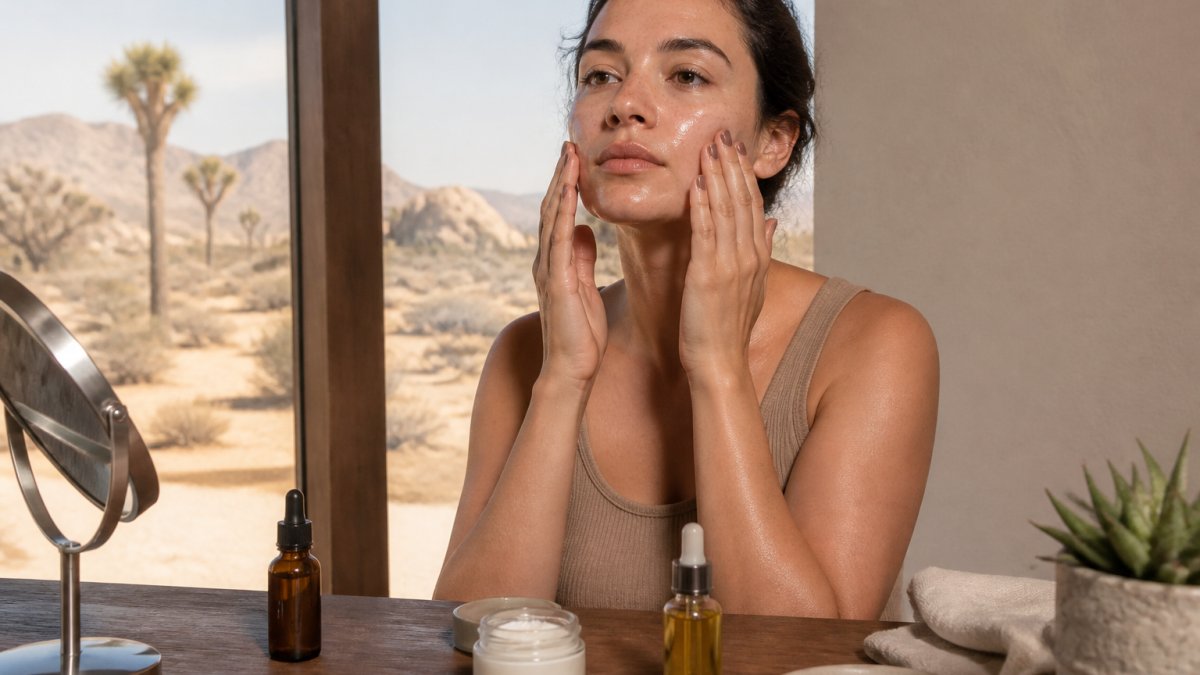
The Gentle Desert Protocol: Step-by-Step
The Gentle Desert Protocol is a foundational approach to moisturizing in arid conditions, maximizing hydration while maintaining barrier integrity.
Step 1: Cleanse with intention. Use a gentle, oil-based cleanser that removes environmental debris without stripping natural lipids. Avoid hot water, which accelerates transepidermal water loss; lukewarm is ideal.
Step 2: Apply humectant serum to damp skin. While skin is still slightly damp, apply the Organic Desert Nectar Serum.
Step 3: Seal with oil or cream. Within 2-3 minutes of the serum, apply the Organic Nourishing Oil or Organic Replenishing Cream.

Morning Routine for Sun-Exposed Days
Morning routines in dry climates should prioritize lightweight textures that don't feel heavy under makeup or in daytime heat.
Start with the Organic Desert Nectar Serum on damp skin after cleansing; it absorbs in 1-2 minutes. Follow with the Organic Replenishing Cream, lighter than the oil but adequate for daytime occlusion.
Apply sunscreen last, after all moisturizing products absorb. In dry climates it's non-negotiable because UV exposure accelerates moisture loss and barrier damage.
Throughout the day, spray the Organic Chaparral Protective Mist lightly over makeup or bare skin whenever dryness returns, for hydration and environmental buffering.
Evening Repair Routine
Evenings allow more generous occlusive products since makeup and daytime comfort aren't concerns. This is when intensive repair happens.
Apply the Organic Desert Nectar Serum to damp skin, follow with the Organic Replenishing Cream, then layer the Organic Nourishing Oil on top. This triple-layer approach (serum → cream → oil) creates maximum occlusive protection, letting skin repair and retain moisture overnight.
The evening routine is also ideal for using the Organic Nourishing Oil as the all-in-one 10-day skin detox protocol if skin needs intensive recovery. Use generously, dabbing onto points around the face and neck with gentle, upward movements.
Building a Skincare Routine for Dry Climates
A sustainable routine adapts to your lifestyle, skin type, and environment. Generic routines fail in desert conditions because they don't account for the intensity of moisture loss and environmental stress.
Adjusting Frequency and Application
In mild climates, moisturizing twice daily often suffices. In dry climates, once-daily application leaves many people uncomfortable by evening. Start with twice daily (morning and evening as above) and assess after two weeks.
If skin remains dry, increase frequency. Some desert dwellers benefit from a midday touch-up with the Organic Chaparral Protective Mist; others apply the full routine three times daily.
Adjust amounts based on your skin's response. Use generously on clean skin. Dab onto points around the face and neck, applying with gentle, upward movements while avoiding stretching the skin.
Portable Routines for Travelers
Frequent travel between climates requires a condensed routine that stays effective without bulk. The Organic Desert Nectar Serum and Organic Chaparral Protective Mist are ideal travel companions, addressing the two most critical functions: hydration and environmental protection.
For travel, prioritize the serum (hydration foundation) and mist (environmental buffering). If luggage allows, add the Organic Nourishing Oil for evening repair. Skip the Organic Replenishing Cream if space is tight.
When traveling between dry and humid climates, keep the same core routine but adjust amounts: reduce frequency and occlusive product in humidity, then return to full strength immediately upon returning to a dry climate.
When Moisturizer Alone Isn't Enough
Some people with severe dryness, compromised barriers, or specific skin conditions find even a comprehensive moisturizing routine provides insufficient relief.
If skin remains flaky, tight, or uncomfortable after two weeks of the Gentle Desert Protocol, several factors may be at play.
Second, evaluate environmental factors.
Third, consider whether your barrier has been compromised by over-exfoliation, harsh cleansing, or irritants.
Finally, conditions like eczema, psoriasis, and severe rosacea require medical management alongside moisturizing. Moisturizers support skin health but don't treat underlying conditions.
Choosing the best natural moisturizer for dry climate conditions requires understanding how low humidity and intense sun change your skin's needs.
Frequently Asked Questions
What is the best natural moisturizer for a dry climate?
The best natural moisturizer for dry climates combines hydrating ingredients like sodium hyaluronate with protective antioxidants such as rosemary and parsley extract. Layering a serum, oil, and cream works better than any single product alone. Organic Desert Nectar Serum ($62) provides sodium hyaluronate for hydration; Organic Nourishing Oil ($112) adds antioxidant protection; and Organic Replenishing Cream ($130) seals moisture. This three-step approach addresses the specific challenges of low humidity and environmental stress.
Which natural ingredients help keep skin hydrated in dry weather?
Humectants like sodium hyaluronate and urea draw moisture into the skin, while emollients such as plant oils smooth the skin barrier. Antioxidants including rosemary leaf oil (rich in carnosic acid) and parsley extract (containing apigenin) protect against free radical damage from sun exposure and dry air. Chaparral, native to desert regions, contains polyphenols that help skin adapt to harsh environmental conditions. These ingredients work together: humectants hydrate, emollients soften, and antioxidants shield against oxidative stress.
Is oil or cream better for dry-climate skin?
Both serve different purposes in dry climates. Oils provide antioxidant protection. Creams seal moisture on top, creating a protective barrier against moisture loss and environmental exposure. For dry climates, layering both is most effective: apply serum first, then oil for nourishment and protection, then cream as an occlusive final step. This combination addresses hydration, nutrient delivery, and barrier repair simultaneously.
How often should you moisturize in a dry climate?
In dry climates, moisturize at least twice daily: morning and night. Morning application protects skin before sun and wind exposure. Evening application allows deeper repair and barrier restoration overnight. Some people with very dry skin benefit from a midday refresh using a protective mist like Organic Chaparral Protective Mist ($55) to rehydrate between applications. Adjust frequency based on your skin's response; if flaking persists, increase to three applications or add a serum layer for extra hydration.